
Industrial Shop-Floor Data Acquisition System
I. System Overview
To meet enterprise needs, the company has developed an industrial data acquisition system. It monitors production operations, process execution, faults and other activities on the industrial shop floor, collects the associated data for each activity, and establishes a process and data display system. It also provides management and technical support personnel with Web-based remote access to status information and data. All acquired data is stored in an industrial database, enabling process playback and traceability. Further statistical analysis of the stored data provides managers with data to support decision-making.
The system reads parameters directly from PLCs and other equipment over industrial buses. Installed sensors and RFID devices also collect data from shop-floor equipment, operations and the working environment, including equipment operating parameters (current, voltage, operating time and faults), operating status (operating, fault, repair and maintenance), and site temperature and humidity. These data are transmitted to the data acquisition server over industrial buses, optical fiber or wireless networks and stored on the database server. Once made available through the publishing server, the acquired data allow real-time shop-floor monitoring through a Web client. Dispatchers and managers can remotely log in to the Web client through a browser to monitor authorized shop-floor areas in real time or retrieve operating data.
II. System Architecture

III. System Functions
◆ Integrate data from multiple previously independent equipment control systems into one organized system. The browser/server (B/S) architecture provides an at-a-glance view of all key data through the Web, anytime and anywhere.
◆ Real-time data storage: key parameter information from critical equipment can be stored at millisecond intervals, with high reliability and high compression, to support real-time data display and historical trend analysis.
◆ Supports communication through interfaces such as OPC, ODBC, RS232 and DDE, connecting to SCADA, DCS, PCS, PLCs, various measuring devices and other software systems.
◆ Statistical analysis of acquired data identifies abnormalities promptly and notifies relevant personnel through on-site warning lights, email, mobile text messages and other methods, helping ensure that incidents are handled promptly.
◆ Acquired raw data can be statistically processed and analyzed according to the requirements of other systems, ensuring accurate and timely data for systems including ERP, MES and QIS.
◆ Flexible system settings and interfaces accommodate future expansion at minimal cost.
ZEVON Industrial Technology Data Acquisition System
Smart manufacturing depends on shop-floor production data. During manufacturing, CNC machine tools serve not only as production tools and equipment but also as nodes in the workshop information network. Automatically collecting, aggregating, analyzing and feeding back machine data, and applying the results to manufacturing improvements, can substantially increase manufacturing flexibility and machining-process integration, improving production quality and efficiency. The Gailepu MDC system helps enterprises address this challenge.
MDC (Manufacturing Data Collection & Status Management), a production data and equipment status acquisition, analysis and management system, primarily collects working and operating status data from CNC machine tools and other production equipment. It enables equipment monitoring and control, analyzes and processes acquired data, and can also provide data to software such as MES and ERP. Combining machine-tool data acquisition with machine-tool data analysis and processing, MDC is a shop-floor application management and decision-support system offering data acquisition, machine monitoring, data analysis and processing, report output and other functions.
Through intelligent integration with CNC systems, PLC systems and the electrical control sections of machine tools, MDC automates machine data acquisition without requiring manual operator input, helping ensure timely and accurate data. For acquired-data mining, MDC provides specialized analysis and processing, tailored data processing and a wide range of graphical reports. It statistically processes and analyzes key machine and production data, including power-on rate, spindle running rate, spindle load rate, NC running rate, failure rate, overall equipment effectiveness (OEE), equipment productivity, component pass rate and quality percentage. Accurate data are promptly distributed to the departments responsible for the relevant processes, guiding, responding to and reporting shop-floor production activity in real time. This greatly improves problem-solving capability and advances smart manufacturing in the workshop.
For most manufacturing enterprises, automatic data acquisition from measuring instruments has long been troublesome. Even when instruments have RS232/485 or similar interfaces, staff still often take measurements while recording results manually on paper, then enter them into a PC for processing. This creates a heavy workload and cannot ensure data accuracy; managers often receive data that are already one or two days old. Efficient, straightforward, real-time collection of information about defective products and related production quantities on site is an even greater challenge.
Data Acquisition Functions
- Acquire production-line output quantities, defective-product quantities or production-line fault types (such as line stoppages, material shortages and quality issues) in real time and transmit them to the database system;
- Receive information from the database, such as production schedules and material information;
- Transmit the names and quantities of defective products from inspection stations;
- Connect measuring instruments to digitize inspection. The data acquisition unit automatically obtains measurements from the instruments, records them, performs analysis and calculations, generates relevant charts, and automatically evaluates the results. Examples include runout measurement of machined components and plotting force curves from tensile force gauges;
Data Acquisition Features
- RS232 and RS485 serial ports connect multiple measuring instruments for automatic data acquisition; integration with PLCs, RF electronic tags and other devices;
- A USB interface facilitates data export;
- An RJ45 interface provides network access through an Ethernet cable;
- VGA video output and audio output interfaces;
- A built-in Wi-Fi module provides wireless access for convenient on-site networking;
- Supports up to 32G of data storage;
- A 4.3-inch touchscreen facilitates operation;
- Users can retrieve data through an interface from any PC on the network, facilitating secondary development;
- Supports mobile measurement and immediate data transmission, or uploading data over the network after testing is complete;
- The power supply supports 6 hours of continuous operation and up to 10 days of standby. Shop-floor data acquisition is a very important part of the quality process. A good data acquisition solution frees quality management personnel from burdensome data processing, giving them more time to solve actual quality problems. Immediate data acquisition also enables genuinely real-time monitoring, allowing problems to be identified early and greater losses to be avoided.
Supports commonly used controllers and communication protocols on the market. Custom development for different sites can meet communication requirements. Integration of on-site equipment systems links the production process control layer with enterprise operations management. Networking upgrades to critical equipment enable data exchange between the equipment layer and information management systems. This makes the management of products, production progress, production efficiency, quality information and equipment operation more visual, digital and intelligent, improving productivity and product quality while reducing production costs and energy consumption. These capabilities provide digital control of production processes to support lean production advantages, further improving the connectivity, digitalization and intelligence of manufacturing and progressively enabling smart manufacturing.
Application Requirements
Data Acquisition:
Build a plant-wide data integration platform to interconnect equipment and acquire data in real time, provide centralized storage management and unified data services for the whole plant, and visualize production data.
Equipment Networking:
Much of the equipment, including bottle washers, sterilization equipment, freeze-drying equipment, reactors and testing equipment, is not networked and remains in isolated information silos.
Equipment Status Monitoring:
Equipment operating status cannot be monitored remotely, and key process parameters cannot be acquired automatically during production.
Report Management:
Report management lacks support from an advanced management system and still relies on Excel.
Visual Displays:
Shop-floor production status lacks transparency, preventing managers from monitoring production remotely.

Benefit Analysis


System Advantages
Production Visualization
Visualize and make transparent production activities such as schedule completion, process execution and equipment operating status. Automatically generate production reports to strengthen on-site management.
Prompt Monitoring of Abnormalities
Production processes can be monitored remotely in real time and connected to video systems to identify production abnormalities promptly.
Preventive Risk Control
Parameter limit warnings are sent through DingTalk, email, WeChat, SMS and other channels to identify risks promptly and improve enterprise safety management.
Access from Multiple Devices
Supports access and monitoring from PCs, mobile phones, iPads and other devices.
Automatic Upload
When switching products, product recipes and process parameters are automatically uploaded to the equipment controller.
Broad Compatibility
Works with commonly used controller brands and communication protocols on the market.
Operation During Shutdown
Communication upgrades can be performed without stopping equipment or affecting production.
Direct Reading
The system can read equipment controller communication protocols directly, without requiring the original equipment manufacturer to provide the control program.
Data Exchange
Supports M2M functionality, enabling data exchange between equipment in separate information silos.
Recovery After Network Outages
Supports local caching during network outages. Data are uploaded when the network is restored, helping ensure data completeness.
Supporting Database
An industrial real-time database supports updates to large volumes of data.
Remote Operation and Maintenance Support
Supports remote operation and maintenance.
Multiple Communication Options
Supports common communication methods including OPC UA, WEBSERVICE, MQTT and BACnet.
On-Premises and Cloud Deployment
Supports both on-premises and cloud deployment.
Professional Services
Specialized services for smart factories and enterprise digital information systems.


Instrument Data Acquisition
Data Acquisition—Comprehensive Tester Data Acquisition—Withstand Voltage Tester Data Acquisition—LCR Bridge Instrument Data AcquisitionInstrument data acquisition for ceramic components, inductors, capacitors, resistors and discrete components
Tonghui instrument data acquisition, Youce data acquisition instrument data acquisition, Zhixin instrument data acquisition
Option One: Collect Pass/Fail Data Only:
Electrical performance testing: Collect I/O signal levels from the instrument's sorting signals; this is feasible with virtually all instruments.
CCD appearance testing: Integrate with CCD software. Currently, none of the equipment's CCD software supports this; equipment manufacturers need to be encouraged to add the corresponding function.
Option Two: Collect Detailed Test Data:
Electrical performance testing: Collect through the instrument's RS232 port; this is feasible with virtually all instruments.
CCD appearance testing: Integrate with CCD software; the software on some equipment supports this.
Real-time data acquisition: Real-time collection of test data, database storage and Web-based visual queries
Automatic report generation: Customize quality reports to customer requirements, such as CPK, control charts and P charts
Intelligent data alerts: Intelligent analysis of test data and periodic quality warning emails, such as abnormal first-pass yield and CPK alerts
Function Description:
1. Automatically calculate CPK for all products manufactured the previous day, every day; email alerts are sent automatically when CPK is below the required level, for example CPK<1.33.
2. Calculate CPK for all products online, helping quality personnel analyze daily production and processing quality.
3. Support queries of historical CPK alert data.
Function Description:
1. Support daily/monthly first-pass yield reports for individual products.
2. Support monthly quality reports for all materials in production that month.


Equipment Data Acquisition
Industrial big data acquisition provides the data foundation for industrial innovation and strategic development. It is also essential for building digital factories, achieving intelligent manufacturing and moving toward Industry 4.0. Industrial production equipment is a vital part of industrial production, and its various data directly affect product and factory management.
A digital factory is not the same as an unmanned factory. The more complex and variable product configurations and manufacturing processes become, the more human participation is needed. In digital factories, workers increasingly handle exceptions and adjust equipment. Yet data acquisition remains a longstanding difficulty for manufacturers: automation equipment comes in many brands and types, with different manufacturers and data interfaces, limited local support from overseas suppliers and different purchase dates. Even automatic acquisition of output and downtime does not mean data from the entire manufacturing process has been captured. Wherever manual involvement remains, the data is still incomplete.
Industrial Production Equipment Data Acquisition Methods
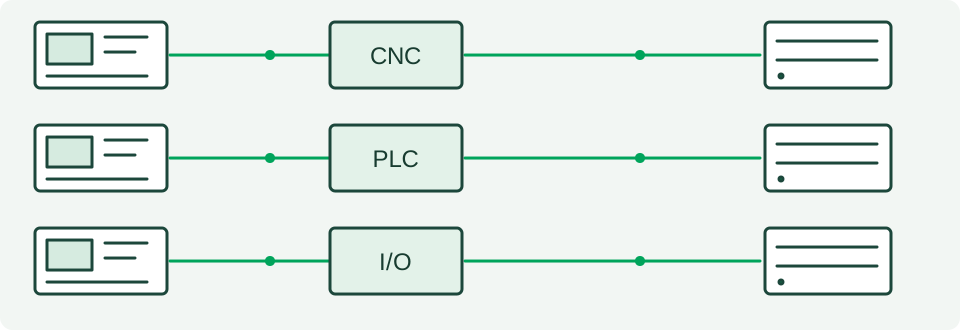
There are three methods of acquiring industrial production equipment data:Direct network communication with the data system,Acquisition through industrial gateways and Acquisition through remote I/O.
1. Direct Network Communication
Direct networking uses the CNC system's own communication protocol and network port to connect directly to the workshop LAN and communicate with the data acquisition server, without additional hardware. Server software displays, summarizes and analyzes the data. It generally collects machine power-on, power-off, running, paused and alarm states, and records alarm information.
High-end CNC systems include Ethernet ports for data communication. Different data transmission protocols enable real-time monitoring of CNC machine operating status. FANUC 0i / 31i / 18i series CNC systems have network ports on the rear of the operating panel and support direct network communication through FANUC's FOCAS protocol. Siemens 840D systems with PCU50 versions or above can also communicate directly over the network using OPC.
2. Industrial Gateway Acquisition
For CNC systems without an Ethernet interface or Ethernet communication support, an industrial Ethernet gateway can connect to the machine's PLC controller to acquire equipment data and obtain real-time power-on, power-off, running, paused and alarm states.
Industrial communication gateways convert messages between network protocols, translating the communication protocols of different workshop PLCs into one standard protocol through which the acquisition server obtains real-time information from shop-floor PLC equipment.
3. Remote I/O Acquisition
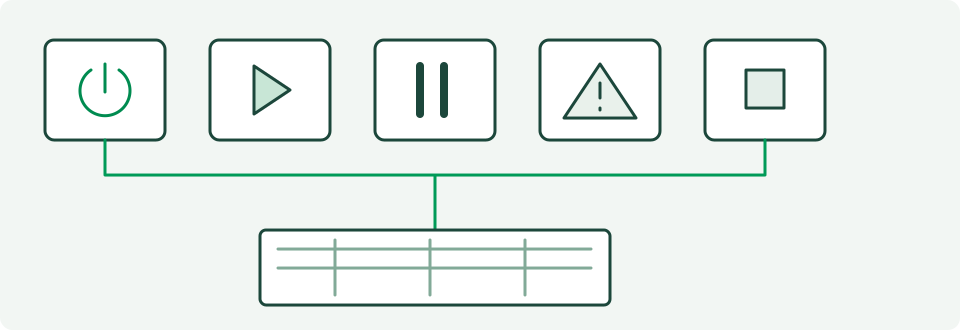
For equipment that cannot communicate directly through Ethernet and has no PLC control unit, remote I/O can acquire operating data, including real-time power-on, power-off, running, alarm and paused states.
A remote I/O module is an industrial-grade remote acquisition and control module that collects digital inputs from dry contacts. Analysis of the equipment electrical system identifies the required signals, which are connected to the remote I/O module. The module converts electrical digital and analog signals into network data and sends it to the acquisition server through the workshop LAN.
Remote Data Acquisition
Kechuang ZEVON--Remote Data Monitoring System Solutions
The remote data monitoring system integrates the Internet of Things,sensors, cloud computing, big data, mobile Internet, geographic information and other new-generation information technologies. Intelligent acquisition terminals upload data to a cloud platform for storage, organization and analysis. An equipment big data platform digitizes equipment management, enables remote maintenance and visualizes equipment status. It monitors status in real time, shortens maintenance cycles, reduces maintenance costs, improves service quality and maintains competitive advantages. Seamless data connectivity helps users build remote operations and maintenance service platforms reliably and quickly, optimize their energy mix and reduce operating costs.

Data Applications

Multi-Device Delivery
Supports display on large screens, computers, mobile phones, WeChat and other clients
Equipment Distribution
Specific equipment locations across regions; basic information: power-on, stopped, alarm counts and online/offline status
Process Flow
Visual and graphical display of the main system operating items
Status Monitoring
Real-time display and historical queries based on predefined data models and monitoring rules at different levels
Real-Time Curves
Live curve refresh; compare data from multiple devices on the same screen
Meter Reading and Measurement
Measurement statistics by year/month/day and other periods for instruments with metering functions
Remote Debugging
Remotely debug and manage equipment operating programs for efficient, convenient commissioning and control
Energy Management
Real-time monitoring and management of equipment operating energy consumption, with analysis and optimization recommendations
Alarm Management
Exception alarms based on preset fixed thresholds, dynamic thresholds, real-time data and other strategies
Multimedia Sensing
Supports video integration, scheduled uploads, event/alarm linkage, remote voice announcements and other multimedia sensing functions
Cloud Platform
7*24-hour uninterrupted service; large-scale data acquisition and storage; real-time delivery, alerts, trends, reports, big data analytics and other services
Big Data Analytics
Supports alarm data analysis, historical analysis, real-time analysis and comprehensive operating efficiency analysis

System Integration
The remote data monitoring system brings managers, production departments, equipment manufacturers, maintenance personnel and related organizations onto a unified service platform. It enables equipment status supervision anytime, anywhere, allowing specialists to professionally manage and maintain equipment operation, reduce on-site maintenance workload, improve maintenance efficiency and lower the risk of equipment failure downtime.